
'India in 2020 is a lot better prepared than in 1962.' 'It is no longer a pushover; and anything other than a crushing Chinese military victory will be a major loss of face for China,' observes Rajeev Srinivasan in the first of a three part column.

'From Doklam to Wuhan and the return of the India-China relationship to its previous equilibrium is indeed a major contribution of President Xi and PM Modi. Without any doubt they deserve the kudos for their sagacity and their wisdom,' says Ambassador Gautam Bambawale, India's envoy to China during the Wuhan summit.

The US has been, historically, a sleeping partner in India-China relations. Today, any attempt by the Modi government to make a bilateral move to improve relations with Beijing could upset Biden's apple cart, notes Ambassador M K Bhadrakumar.

An article said Modi's decision to provide e-visas for Chinese nationals is inadequate and it should be extended to business and work visas.
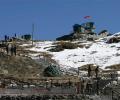
India may hold the promise of a big market for China, but that promise is yet to be fulfilled

Outlining seven principles of engagement for closer cooperation between India and China, Prime Minister Manmohan Singh on Thursday said the two countries should show sensitivity to each other's interests and sovereignty and move quickly to resolve the boundary issue.
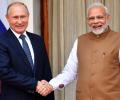
It also took exception to Australian Foreign Minister Julie Bishop's call for resolving the Doklam issue peacefully

Being a pragmatist Modi is not likely to give preference to China over Japan. Both security and economic aspects are likely to shape Modi's decision in terms of engaging the two biggest economies of Asia, says Sana Hashmi.

Xi and Modi met soon after their arrival at a summit of the BRICS group of emerging powers. Xi said the two countries should join hands in setting global rules and suggested he attend the November meeting of the 21-nation APEC in Beijing, as well as take part in Chinese-led regional initiatives.
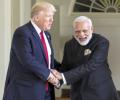
'Washington senses that the anchor sheet of India's strategic autonomy lies in its longstanding partnership with Russia, which remains firm and immutable despite the changes in world politics in the post-Cold War era,' notes Ambassador M K Bhadrakumar.<

Once again an Indian prime minister has realised that with Pakistan and China, things will not move as he wishes.

'China, much more than Pakistan, is a credible potential adversary with the ability to hurt our interests.' 'It must figure higher in our national security concerns,' says Vice Admiral Premvir Das (retd).

Future conflict will involve bypassing of frontiers to strike at critical vulnerabilities directly and in the hinterland at the appropriate time, explains Lieutenant General Anil Chait (retd), who served as chief of the Integrated Defence Staff and Central Army Commander.

'Indian diplomacy faltered amidst multiple failures of statecraft.' 'The functionaries responsible must be held to account for their abject failure,' asserts Ambassador M K Bhadrakumar.

For a rising country like China with its sights set on global and regional power, any coming together of the US and India is the worst case scenario. Hence, China is concerned with the emerging equations between New Delhi and Washington, says Srikanth Kondapalli.

The PM will meet Mongolian President Tsakhiagiin Elbegdorj on his first ever visit to the country.
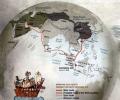
China's desire to have India as part of its ambitious Maritime Silk Route makes strategic sense for both nations. However, it would involve substantive assurances from Beijing, says Dr Rahul Mishra

'The Panchsheel Agreement is unique in the annals of international relations as it stands out as a bizarre illustration of a prime minister trading his country's crucial national interests solely to buffer his personal international image,' feels R N Ravi.
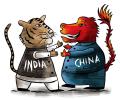
'China's vulnerability on the global stage has given an opening to India to push for its own interests,' notes Harsh V Pant.
'We've never really been in the situation of having a difficult time with the Chinese and an increasingly difficult time with the Russians along with a relationship with the Americans which is important.'
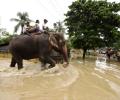
However, Beijing expresses readiness for talks to reopen the Nathu La pass for the Kailash-Mansarovar Yatra.

The BRICS summit made clear that China's support for Pakistan is unwavering. China will continue to pressure India to ease tensions with Pakistan and resolve the Kashmir dispute.
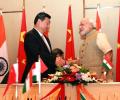
Chinese President Xi Jinping pledged on Thursday to give Indian companies and products - especially including those made by the pharmaceutical, farming and fuel industries - greater access to Chinese markets.
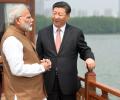
The BRI, a pet initiative of President Xi, is aimed at promoting network of roads, ports and rail networks all over the world to spread China's influence.

'There will be some issues of contention, especially on H1B visa and on trade policy.'
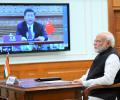
'If Asia does become a Chinese dominated space, it will not only be because India failed to get its economic act together but also because it did not stand up for its democratic credentials,' warns Shyam Saran, the former foreign secretary.
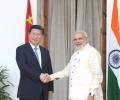
'It needed political courage on the part of the prime minister to make such an intervention at the present juncture when the hawkish opinion rules the roost in the Indian foreign-policy discourses in our media, and, unfortunately, the sane voices have largely fallen silent,' says Ambassador M K Bhadrakumar.

On his recent visit to China, the President made eminently sensible suggestions to improve relations except that they can't work in the present atmosphere.

Modi knew in his heart that India does not have the financial muscle to support the new bank with offers of co-financing international projects, something China can do from the bank's base in Shanghai. If established in Mumbai, it may have employed a few Indian bankers and satisfied the national ego but there was little financial value to be drawn from it.

'We are against Alibaba investing in Paytm.' 'We are against the concessions given to Paytm.' 'In fact, we want Paytm to close down because of its alliance with Alibaba.'
'Even if such a thing happens, it will not prolong for many days like Doklam did.' 'That is because both the leaders do not want it.'

He stressed the need for strengthening mutual trust and confidence while seeking solutions to outstanding issues.

If the chemistry between Modi and Xi Jinping goes well, it will herald a new future not just for the region but for the world, says Tarun Vijay.
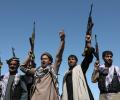
'But an overthrow of the Afghan government would really embolden regional militant groups in a big way.' 'LeT and JeM could be emboldened, and prompted to replicate in Kashmir what the Taliban did in Afghanistan.'

Modi was expected to arrive in Wuhan in the evening on April 26 and join Xi in the informal summit at a picturesque location the next day.
'India's preference today seems to be to exploit the deepening chill in relations with China to breathe new life into its meandering partnership with the US,' argues Ambassador M K Bhadrakumar.
'We must compartmentalise issues, ensuring that one disagreement does not sour everything,' advises Ambassador Kishan S Rana.

Being attended by nearly 40 countries and leading groupings like the European Union, the annual conference of the Heart of Asia -- Istanbul Process is deliberating on various challenges facing Afghanistan, including revival of a peace process in the conflict-ridden country.

'Both Modi and Xi know that if all that there is to show for Modi's visit -- barely eight months after Xi's India trip -- is a repeat of the same old declarations, there will be a terrible sense of letdown in the public mood resulting in future summits losing credibility. Only the possibility of new ground being broken can justify Modi's trip at this time,' says B S Raghavan.

India and China on Friday agreed to seek a "political" solution to the border dispute at the earliest as Prime Minister Narendra Modi asked Beijing to "reconsider its approach on some issues" and announced CBMs like e-visa for Chinese tourists and operationalisation of hotline between two militaries.
 © 2026 Rediff.com - Advertise with us - Disclaimer - Privacy Policy - Sitemap - Feedback - About us - Terms of use - Grievances